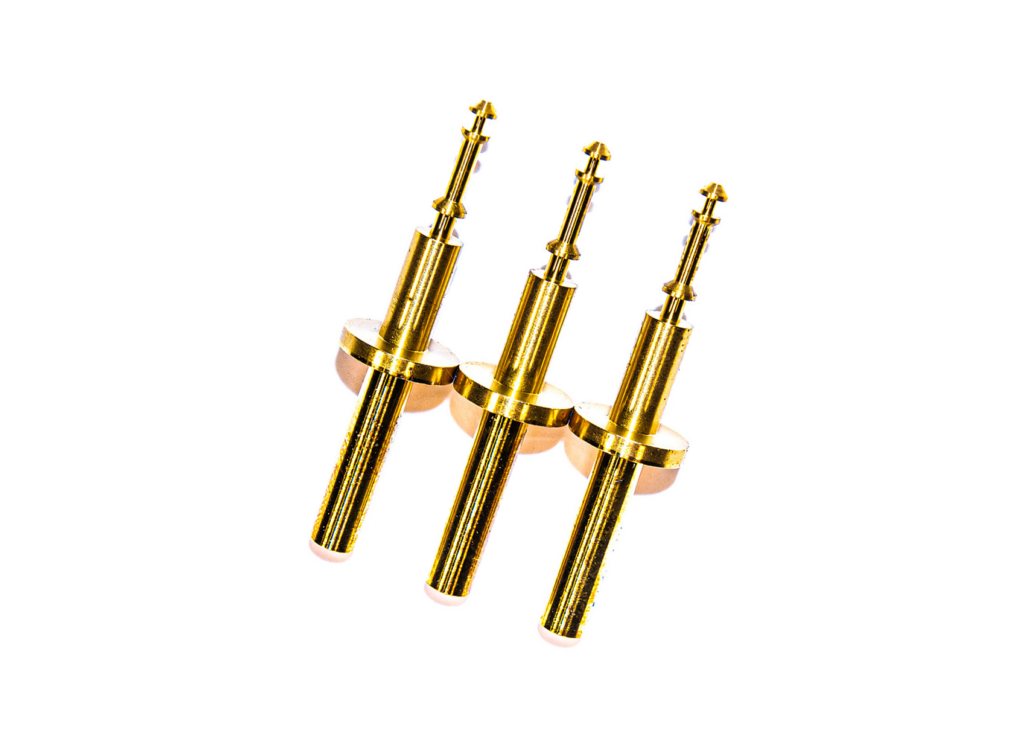
Brass has long been a material for high-volume precision turned parts. It works for plumbing fittings, electrical connectors, medical devices, and instrumentation components. Its machinability, corrosion resistance, and dimensional consistency make it an ideal candidate for automatic screw machines, which can produce thousands of identical parts per shift with minimal operator intervention.
Grovtec understands the characteristics of their major automatic screw machine platforms like Acme, Tornos, Davenport, and Wickman. This is essential when our Oregon screw shop is specifying parts correctly, qualifying suppliers, and ensuring the right machine is matched to your application.
Brass and Automatic Screw Machines Are a Natural Fit
Brass alloys, particularly free machining grades like C36000 (360 brass), were practically engineered with the automatic screw machine in mind. The high lead content in C36000 produces short, metallic dust and waste, that clears cutting zones easily, reduces tool wear, and allows aggressive feed rates. This translates directly to higher throughput and longer tool life on multi-spindle and single-spindle cam-driven machines. ECO brass, or lower-lead based brass like C69300 is also available.
From a buyer’s perspective, this means:
- Lower cycle times compared to stainless or aluminum alloys of similar complexity
- Better surface finishes with tighter tolerances, often holding ±0.001″ or better on diameter
- Excellent thread form quality due to brass’s low work hardening tendency
- Broad supplier availability, since virtually every screw machine shop runs brass
The four major platforms
Acme-Gridley (Multi-Spindle)
The Acme-Gridley is an American icon of mass production. These large, multi-spindle machines, typically 6 or 8 spindles, index bar stock through multiple cutting positions simultaneously. Each machine cycle produces one completed part per index. For brass, this is extremely efficient: a well set Acme can produce simple to moderately complex parts at rates of several hundred to over a thousand pieces per hour.
Specification Note: Acme-Gridley machines are best suited for parts with moderate complexity where you need very high volume. They shine on parts with multiple turned diameters, cross-holes, and thread forms that can be divided across multiple stations.
Bar capacity ranges from 5/8″ up to 2-5/8″ depending on the model. For brass parts in this range — think hydraulic fittings, valve stems, or electrical brass bushings — the Acme is a workhorse. Tooling change-over time is significant (typically a full shift to retool), so these machines are most economical on long runs of 50,000 pieces or more.


Tornos (Single and Multi-Spindle Swiss-Type)
Tornos is a Swiss manufacturer with a long heritage in precision screw machine technology. Their cam-driven single-spindle sliding headstock machines are uniquely capable of producing extremely long, slender parts that would deflect unacceptably on a fixed-headstock machine. The guide bushing supports the workpiece immediately at the cutting point, enabling length-to-diameter (L x D) ratios of 10:1 or greater, something that standard lathes struggle to achieve.
Specification Note: If your brass component has a high length-to-diameter ratio (e.g., a long shaft, pin, or cannula style part), Tornos sliding headstock machines are often the only practical choice, as Tolerances in the sub-thousandth range are achievable.
Tornos also manufactures multi-spindle cam automatics (notably the Delta and SAS series), which bring Swiss precision to higher volume production. These machines are especially common in European supply chains and among precision component makers serving medical, instrumentation, and aerospace sectors. For brass, Tornos machines produce exceptional surface finishes and are well suited to close tolerance work that also demands volume.
Davenport (5-Spindle Multi-Spindle)
The Davenport is an American designed, 5-spindle automatic with a distinctive vertical spindle carrier. It occupies a middle ground between the massive Acme-Gridley and the single-spindle Swiss-type: more flexible than the Acme for moderate-complexity parts, and significantly faster than single-spindle machines for medium volume work.
Davenports are particularly well regarded for small to medium brass parts, like connector bodies, standoffs, small valve components up to about 1″ diameter. Their shorter cam changeover time (relative to Acme) makes them more economical for runs in the 10,000 to 200,000 piece range. Many shops run Davenports specifically because they bridge volume ranges effectively.
Specification Note: The Davenport’s 5-spindle layout means part complexity is somewhat limited compared to a 6 or 8 spindle machine. However, for rotationally symmetric brass parts with straightforward turning and threading, it is a very cost effective platform.


Wickman (Multi-Spindle)
Wickman is a British-designed multi-spindle automatic screw machine with a strong following in UK and European precision engineering shops. Available in 6 and 8-spindle configurations, Wickman machines are comparable in concept to the Acme-Gridley but reflect European engineering preferences.
For brass parts, the Wickman delivers the same fundamental advantages as other multi-spindle platforms: high throughput, consistent quality, and efficient use of free machining brass alloys. Wickmans have a particularly strong reputation in the UK valve and fittings industry, and buyers sourcing from British or European job shops will frequently encounter them.
Specification Note: When qualifying a Wickman equipped supplier, confirm the tooling capability and gauge the complexity of parts they routinely run. A well maintained Wickman in experienced hands can produce brass parts to the same standards as any comparable multi-spindle platform.
Considerations when specifying brass parts for screw machine production
Material Grade
C36000 (360 brass) is the standard recommendation for automatic screw machine work. It’s the most free machining copper alloy available and is compatible with all four machine platforms. If your application requires lead-free brass (e.g., potable water contact per NSF/ANSI 61), specify C87850 or C69300 bismuth/silicon brasses, but be aware that these grades are harder on tooling and may require adjustments to feeds, speeds, and cycle time estimates.
Tolerances and Surface Finish
A practical rule of thumb: automatic screw machines running free-machining brass routinely hold ±0.001″ on turned diameters as a process capability, with ±0.0005″ achievable with care. Swiss-type (Tornos) machines push tighter still on small diameters. When writing tolerances on drawings, avoid specifying tighter than necessary. This can add costs without benefit if the application doesn’t require it.
Surface finish in the range of 63-125 Ra microinch is typical off the machine without secondary operations. If you need better finish, specify it explicitly, as it may drive burnishing or post-machining steps.

Secondary Operations
All four machine types can be paired with in-line or offline secondary operations. These include cross-drilling, milling flats, knurling, slotting, and thread rolling. When designing brass parts for screw machine production, consider whether secondary ops can be integrated into the machine cycle (preferred, lower cost) versus requiring a separate setup. Work with your supplier early in the design process to optimize for the platform they run.
Run Quantity and Economic Lot Size
These are general guidelines, actual break-even points depend on part complexity, material cost, and other contributing factors. Grovtec will always run a comparison quote across platforms if volumes are in transition zones.
Machine type strongly influences economic order quantities. As a rough guide for brass parts:
- Single-spindle Swiss-type (Tornos): economical from low volumes (500+) for complex or tight-tolerance parts
- Davenport 5-spindle: economical from mid-volumes (5,000–10,000+) for small-to-medium brass parts
- Acme-Gridley or Wickman 6/8-spindle: most cost-effective at high volumes (50,000+) due to setup investment
Working with your supplier
Regardless of the machine platform, the best outcomes in brass screw machine work come from early and open engagement with your supplier. Share your full design intent, not just the drawing, so we can flag features that add cost without function. The four platforms covered here represent decades of proven technology, and experienced operators running brass on Acme, Tornos, Davenport, or Wickman machines can be valuable partners when preparing for manufacturing for sustainable outcomes.
If your interested and looking for a new supplier, it’s worth walking our floor to see the machines themselves, the condition of tooling, and how bar stock is handled and stored. Brass is relatively forgiving, but contaminated or mixed-alloy bar stock is a silent quality risk. A well-run screw machine shop will have clear material traceability and consistent in-process gauging.
Summary
Brass and automatic screw machines are a pairing that has driven precision component manufacturing for over a century. The Acme-Gridley, Tornos, Davenport, and Wickman platforms each bring different strengths to the table in terms of volume capacity, part complexity, and precision. The right choice depends on your specific requirements. As a buyer or engineer, understanding these differences helps you mitigate risk, and ultimately receive brass components that perform exactly as intended.